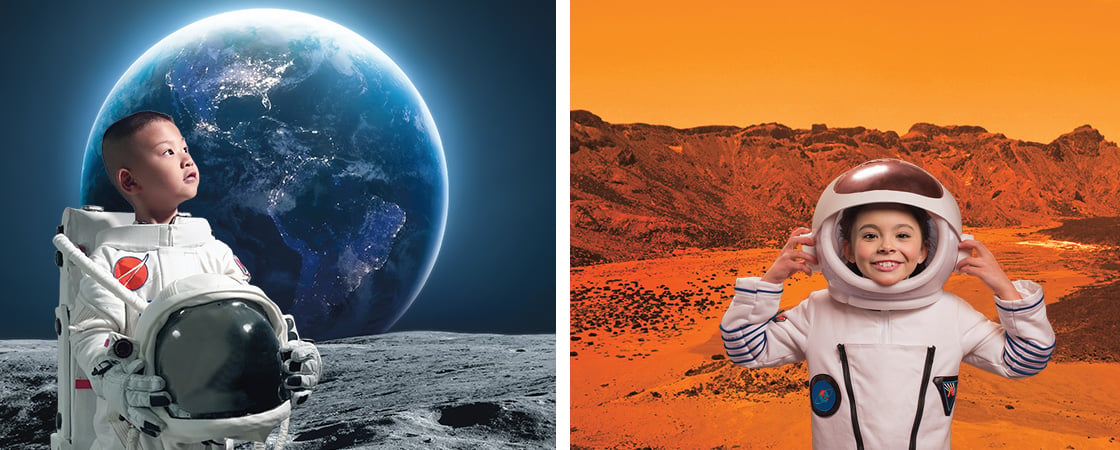
Composite image of a boy holding his helmet on the Moon & a girl in a helmet on a red landscape
Shutterstock.com

Would You Like to Go to the Moon? / Would You Like to Go to Mars?

Which destination would you rather visit?

By Alex Winnick

Learning Objective: Students will compare and contrast information from two nonfiction texts.

Lexiles: 530L; 480L

Standards

Story Navigation

Download and Print

Would You Like to Go to the Moon? 

Shutterstock.com

Humans first went to the moon in 1969 and have been back five times since.

Picture this: You’re on a rocket ship traveling 240,000 miles into space. Where are you headed? The moon!

After three days of space travel, you reach the moon’s gray surface. You land in a cloud of dust. Time to explore!

Imagine that you’re on a rocket ship. You are traveling 240,000 miles into space. You’re going to the moon!

You’ve been traveling for three days. You reach the moon’s gray surface. You land in a cloud of dust. Time to explore!

Out of This World Outfit

Out of This World Outfit

Zip! You check your spacesuit before heading outside. It can get way colder and way hotter here than it can on Earth. Temperatures on the moon can drop as low as -410 degrees Fahrenheit and can rise to 250 degrees Fahrenheit!

Luckily, your puffy white suit keeps you safe. And don’t forget your helmet and oxygen tank. You can’t breathe on the moon without them! You’ll wear them at all times to stay safe.

Zip! You check your spacesuit. Then you head outside. It can get way colder here than it can on Earth. Temperatures here can drop as low as -410 degrees Fahrenheit. It can also get way hotter. It can reach 250 degrees Fahrenheit!

You’re lucky. You have a puffy white suit. It keeps you safe. You also have a helmet. And you have an oxygen tank. You can’t breathe on the moon without them! You’ll wear them to stay safe.

Shutterstock.com

Astronauts have left flags and footprints on the moon!

Flips and Footprints

Flips and Footprints

Ready to explore, you take your first steps and whoa! You bounce 10 feet into the air. On Earth, gravity pulls you to the ground. But there’s far less gravity here. Woo! You do a double backflip.

A massive moon mountain rises in the distance. You don’t see any plants or animals though. That’s because there are no living creatures on the moon.

But you do find proof that astronauts have been here before: an American flag. You also see footprints. Since there’s no wind on the moon, these footprints could last millions of years. You add one of your own next to them.

As you continue exploring, you notice one of the enormous holes in the ground. It’s a crater that formed when a giant space rock called an asteroid hit the moon. This collision likely happened millions of years ago.

Suddenly, you see a burst of light in the distance. Uh-oh—it’s another asteroid. Time to get out of here before it hits! You safely blast off in your spaceship, headed back to Earth.


You’re ready to explore. You take your first steps. Whoa! You bounce 10 feet into the air. Gravity pulls you to the ground on Earth. But it’s much weaker here. Woo! You do a double backflip.

You see a big moon mountain. It’s in the distance. You don’t see any plants. You don’t see any animals. There are no living creatures on the moon.

But astronauts have been here before. You find an American flag. It’s proof. You also see footprints. There’s no wind on the moon. So these footprints could last millions of years. You add one of your own. 

You keep exploring. You notice something. A huge hole is in the ground. It’s a crater. It formed when an asteroid hit the moon. An asteroid is a giant space rock. This collision likely happened millions of years ago.

Uh-oh. You see a burst of light in the distance. It’s another asteroid. Time to leave! You blast off in your spaceship. You head back to Earth.

Would You Like to Go to Mars? 

3, 2, 1 . . . Blast off!

Your rocket shoots toward Mars. But you won’t reach your destination anytime soon. The Red Planet is tens of millions of miles away and it will take nine months to get there. Buckle up!

3, 2, 1 . . . Blast off!

You’re in a rocket. It shoots toward Mars, your destination. You won’t get there anytime soon. The Red Planet is tens of millions of miles away. It will take nine months to reach it. Buckle up!

Covered in Red Dust

Covered in Red Dust

Shutterstock.com

Humans haven’t been to Mars . . . yet!

You finally touch down on Mars’s surface. But you can’t just hop outside. You need a special spacesuit to protect you from Mars’s toxic air. An oxygen tank gives you clean air to breathe.

You step outside in shock, looking around at an empty desert covered in red dust. There’s not another living thing in sight. No plants. No animals. You’re all alone, and it’s time to explore!

You know you won’t find any signs of a past visit from astronauts. That’s because humans have never been to Mars before. But something is moving in the distance. It’s a rover! That’s a remote-controlled vehicle. You watch as it climbs over enormous red rocks. Scientists back on Earth are using it to take pictures and measurements.

You finally land on Mars. But you can’t just hop outside. You need a special spacesuit. It will protect you. Mars’s air is toxic. An oxygen tank has clean air. You breathe it in.

You step outside in shock. You look around at an empty desert. It’s covered in red dust. There’s not another living thing in sight. No plants. No animals. You’re all alone. It’s time to explore!

Humans have never been to Mars before. There are no signs of a past visit from astronauts. But something is moving in the distance. It’s a rover! That’s a remote-controlled vehicle. You watch. It climbs over big red rocks. Scientists back on Earth are using it. They’re taking pictures. They’re also taking measurements of things on Mars.

Shutterstock.com

An illustration of a rover on Mars

Powerful Winds

Powerful Winds

You follow the rover toward a giant mountain—Olympus Mons. It’s the largest volcano in our solar system. You head over, jumping 5 feet into the air. Gravity pulls you back down, but it’s not as strong here as it is on Earth.

You check the temperature and see that it’s freezing. Sometimes it drops to below -200 degrees Fahrenheit on Mars! Luckily, your suit keeps you warm. But the temperature isn’t the only danger here. Powerful winds can blow all the red dust into terrifying storms—and they can happen at any moment.

The wind starts to pick up. Uh-oh. Time to get out of here! You blast off in your rocket ship, buckling in for the long ride home.

You follow the rover. It moves toward a giant mountain. It’s called Olympus Mons. It’s the largest volcano in our solar system. You head over. You jump 5 feet in the air. Gravity is not as strong as it is on Earth. But it still pulls you down.

You check the temperature. It’s freezing. Sometimes it drops to below -200 degrees Fahrenheit on Mars! Good thing your suit keeps you warm. But the temperature isn’t the only danger here. Powerful winds can blow all the red dust into terrifying storms. These storms can happen at any moment.

The wind starts to pick up. Uh-oh. Time to get out of here! You blast off in your rocket ship. You buckle in for the long ride home.

THINK AND WRITE

Write a paragraph explaining how the moon and Mars are alike and different. Then explain which you would rather visit and why!

THINK AND WRITE

Write a paragraph explaining how the moon and Mars are alike and different. Then explain which you would rather visit and why!

video (1)
Slideshows (1)
Audio ()
Activities (2)
Quizzes (1)
Answer Key (1)
video (1)
Slideshows (1)
Audio ()
Activities (2) Download All Quizzes and Activities
Quizzes (1)
Answer Key (1)
Text-to-Speech